
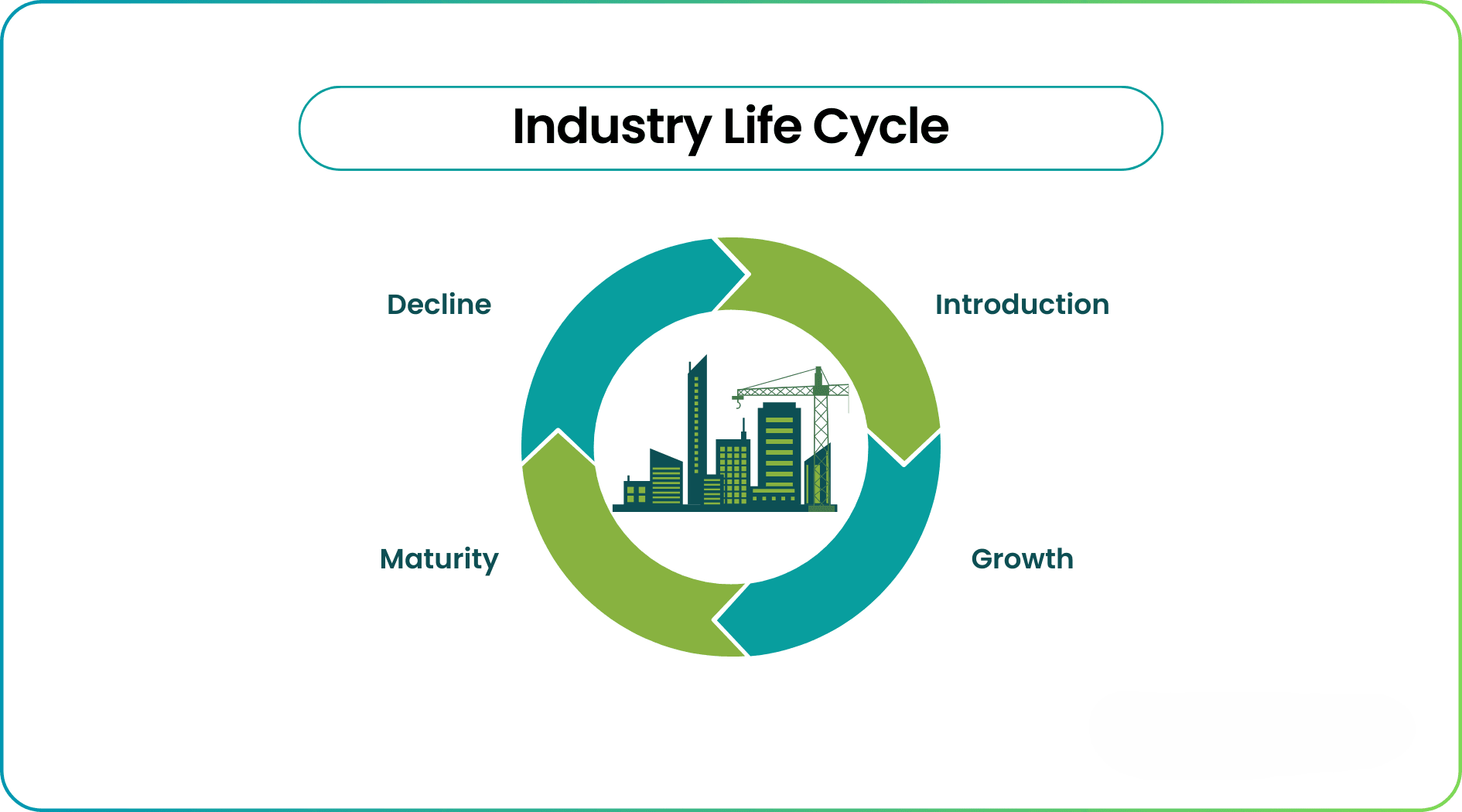
Every market, like every living organism, goes through a lifecycle. It is born, it grows, it matures and eventually, it declines or transforms. For entrepreneurs and enterprise thinkers, understanding these industry life stages is not optional, it is a strategic necessity. It determines when to enter a market, how to compete and when to evolve or exit. Businesses do not fail simply because of poor ideas, many fail because they enter the right idea at the wrong stage.
At the core of industry analysis is the recognition that markets are dynamic, not static. They shift in size, structure, competition and profitability over time. The ability to identify the stage your industry is in gives you a powerful advantage, allowing you to align your strategy with reality rather than assumption.
The first stage is the emergence stage, where an industry is just beginning to form. At this point, market size is small but holds significant growth potential. There is often little to no regulation, minimal competition and high uncertainty. Products and services are still being defined and customer awareness is low. However, this uncertainty is what creates opportunity. Rivalry among players is low because few have entered the space and those who do often differentiate strongly through innovation. The strategic focus at this stage is clear: innovation and experimentation. Entrepreneurs must educate the market, test ideas and refine their offerings. This is the stage where bold thinking is rewarded, but patience is required.
As the market proves its viability, it moves into the growth stage, where expansion accelerates. Demand increases rapidly and more players enter the industry. Market size grows significantly and the environment becomes more structured, though still evolving. At this point, competition begins to intensify, but entry barriers remain relatively low. There is often fragmentation, with no single dominant player and regulations start to take shape. The strategic focus shifts from pure innovation to scaling and growth. Businesses must build capacity, expand their customer base and establish strong positioning. Speed becomes critical, those who scale effectively begin to separate themselves from the rest.
Eventually, the industry reaches the maturity stage, where growth stabilizes. The market becomes saturated and most potential customers are already served. Competition becomes intense, with stronger buyers and higher entry barriers. Established players dominate, and efficiency becomes more important than expansion. Regulation is stable and the industry structure is well defined. At this stage, the focus is no longer on growth at all costs, but on market share and cost efficiency. Businesses must optimize operations, reduce costs and differentiate through branding, quality or customer experience. Profitability depends on how well a company can compete within an already crowded space.
The final stage is the decline stage, where the market begins to shrink. Demand decreases due to changing consumer preferences, technological disruption or external factors. Growth disappears, and many firms exit the market. Competition becomes aggressive, often leading to price wars, reduced margins and financial strain. Access to financing becomes limited, and the industry loses attractiveness. At this point, the strategic focus shifts to harvesting or exiting. Businesses must decide whether to reinvent themselves, pivot to new opportunities, or gradually disengage. Survival depends on adaptability and strategic clarity.
Understanding these stages is not just about classification, it is about strategic alignment. Each stage demands a different mindset, a different allocation of resources and a different competitive approach. Applying the wrong strategy at the wrong stage can be costly. For instance, focusing on aggressive expansion in a declining market or prioritizing cost efficiency in an emerging market can lead to failure.
To effectively apply industry life cycle thinking, enterprise leaders must continuously assess their environment. Key signals to observe include:
- Market growth rate – Is demand increasing, stable or declining?
- Level of competition – Are new players entering or exiting?
- Customer behavior – Are needs evolving or stabilizing?
- Regulatory environment – Is it emerging, stabilizing or restricting?
- Innovation intensity – Is the market driven by new ideas or efficiency?
These indicators help determine where the industry stands and what strategic response is required.
An important insight in enterprise thinking is that decline does not always mean death. Some industries reinvent themselves through innovation, creating new cycles of growth. Others give rise to entirely new industries. What appears to be decline may actually be transformation. Entrepreneurs who recognize this early can reposition themselves ahead of the curve.
Furthermore, different segments within the same industry can exist at different stages simultaneously. While one segment matures, another may still be emerging. This creates opportunities for strategic repositioning, allowing businesses to move into more favorable segments rather than competing in saturated ones.
Ultimately, understanding industry life stages equips entrepreneurs with timing intelligence. It answers critical questions: When should you enter? How aggressively should you grow? When should you optimize? And when should you exit? These decisions define the trajectory of any enterprise.
Markets are not static landscapes, they are evolving systems. Success in enterprise depends not only on what you do, but on when and where you do it. Those who understand industry life cycles position themselves to act with precision, aligning their strategies with the realities of the market. And in that alignment lies the difference between businesses that struggle to survive and those that lead with foresight and control.
Get in touch with the author: https://aaronmuli.com email: hello@aaronmuli.com